The first cold snap of the year always tells the truth. One day you’re fine in a sweater, the next you’re standing in your living room, shivering, staring at that old electric radiator that hums like a tired bee and barely warms your ankles. You open your energy bill, feel your stomach tighten, and your eyes drift to that corner of the room where a wood stove would look so good. Warm flame, soft crackling, the kind of heat that feels like a hug, not a hair dryer.
You grab your phone, type “buy wood stove” and suddenly you’re drowning: kilowatts, yields, labels, pellets, cast iron, convection, sealed stoves, flue diameters.
You just wanted to be warm.
And now you’re afraid of getting it totally wrong.
1. Power: the trap of “the bigger, the better”
The first reflex people have is almost always the same: “I’ll take a powerful stove, just in case.” On paper, a 12 kW wood stove sounds reassuring, like buying a 4×4 “because you never know.” Then winter comes, you light it… and within 20 minutes your living room turns into a sauna. You open a window to breathe, and your precious heat escapes into the street.
Too powerful, too fast, too hot. And a machine that burns badly, smoky glass, wasted wood. Classic scenario.
A heating engineer once told me about a couple in a small stone house, about 45 m² on the ground floor. They proudly bought a huge stove they saw in a showroom, “just like in the magazine.” The model was made to heat 130 m².
The first evening, they were thrilled. The second evening, they were sweating in T-shirts in January. By the third day, they were running it at the lowest possible setting, half closing the air inlets and loading tiny logs “so it doesn’t get too hot.” Result: poor combustion, creosote in the flue, glass blackened in record time, and a stove that never reached its real efficiency.
The right approach is the opposite of instinct. You don’t choose the stove like you choose a car engine, but like you choose a pair of shoes: adjusted to your size, your pace, your daily life. For modern, well-insulated homes, you count around 60 to 80 W per m². For older, poorly insulated homes, closer to 100 W per m². That gives an order of magnitude.
Then you refine with a pro, based on ceiling height, insulation, and how you actually use the room. *A wood stove that’s a little under-sized but used properly often heats better than a monster constantly strangled.*
➡️ Doctors warn: a wave of extreme fatigue is coming – here’s how to avoid it
➡️ What psychology says about people who feel uneasy when things slow down
➡️ Wood-burning stove: the object to place near your firewood this winter
➡️ Chefs explain why seasoning cast iron at low heat lasts much longer
➡️ Spotless shower screens: the hotel trick for streak-free glass
2. Type of stove: ambiance, main heating, or backup?
Before looking at brands, you need to ask the only question that really matters: “What role will this stove play in my life?” Is it just for the joy of flames on winter evenings, or do you want it to genuinely carry a big share of the heating in the house? A small steel stove with a pretty glass window isn’t used like a heavy masonry stove that stores heat for hours.
Some models heat quickly then cool just as fast. Others take longer to start but keep a gentle temperature for half the night. It’s less glamorous to think about than the design, yet it completely changes your everyday comfort.
Picture a family that only comes to their country house on weekends. They arrive Friday evening, the house is at 12°C, they want to warm it up fast. In this case, a reactive steel stove or a pellet stove with automatic ignition makes sense. They light it, the room gains several degrees in under an hour, everyone’s happy.
Now imagine a retired couple spending day and night at home, in a not-so-insulated house. They need a stable, long-lasting heat. They might prefer a cast-iron or soapstone stove, heavier, slower to heat up but more persistent. Same “wood stove” label, totally different usage.
Behind the choice of type lies a question of rhythm. Do you picture yourself reloading logs every 2 hours, enjoying the ritual, or do you know very well that, some days, you’ll light it at 6 p.m. and not touch it again? Let’s be honest: nobody really does this every single day. That’s where pellet stoves come into play, with their hoppers, thermostats, and programs. Less charm maybe, more comfort and regularity.
The key is not to buy “the most beautiful” or “the most fashionable” stove, but the one that matches your actual lifestyle, not the idealized version you imagine on a Sunday afternoon.
3. Installation and safety: the boring part that saves you headaches
There’s a sentence no one wants to read on a property ad: “Non-compliant wood stove installation.” Yet that phrase hides everything that matters most: your attic not catching fire, your living room not filling with smoke, your insurance actually covering you in case of a problem.
Choosing the right stove without thinking about the flue, the floor protection, or the minimum distances from walls is like buying a sports car and ignoring the brakes. On the day of installation, real life catches up with theory. And it sometimes hurts.
A common story: someone buys a little second-hand stove online, “a great deal,” with no professional advice, and calls a random handyman to “connect it quickly, it’s just a pipe.” The flue is undersized, badly insulated, and goes through a wooden ceiling without proper clearance. The stove smokes, draws badly, clogs the chimney.
One chilly night, a log rolls a bit too far on the hearth. It falls against a synthetic rug that was placed “just for decoration.” It melts, releases fumes, and everyone spends the evening with the windows open in -2°C. No drama that time, but a neat summary of everything that can go wrong when safety is an afterthought.
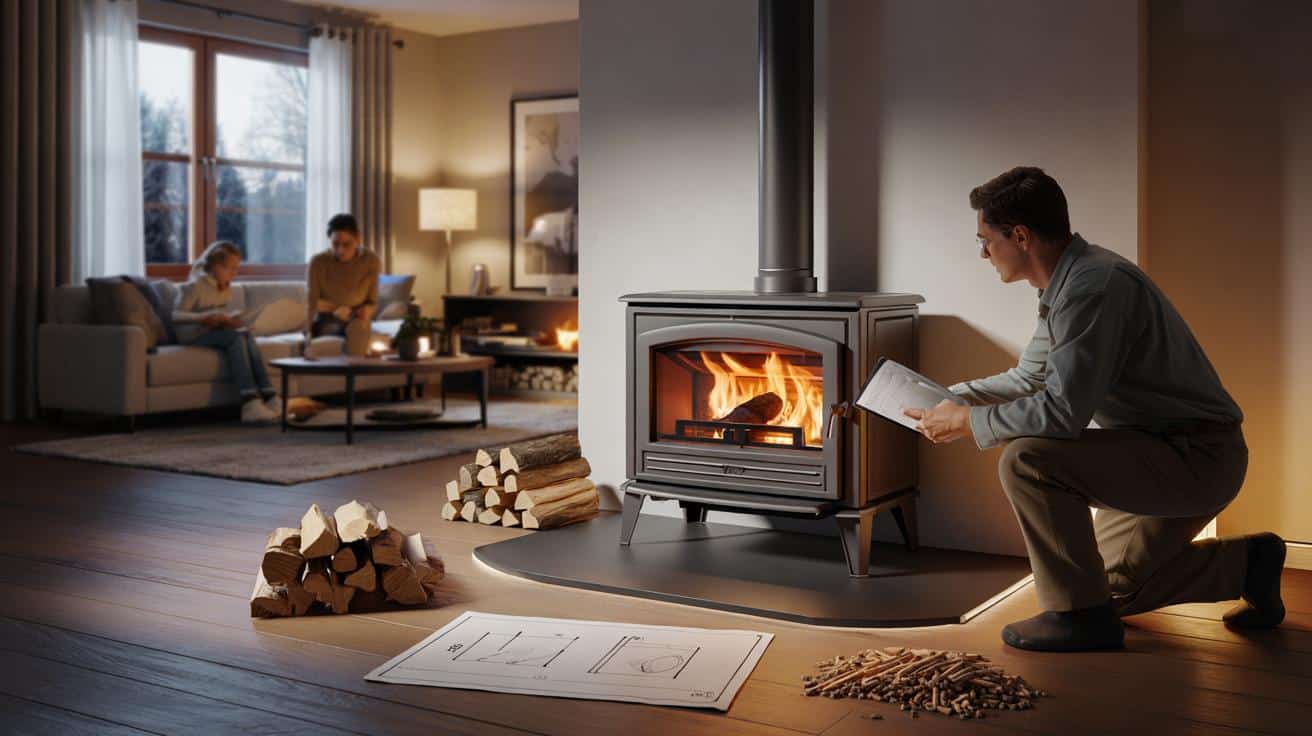
A good professional doesn’t just sell a stove. They check the existing flue (or propose one), calculate the height, choose the right diameter, and adapt the connections to your home. They’ll talk about fresh-air intake, floor protection, and wall clearances. It may sound fussy, yet it’s precisely what allows you to light a fire and then forget the technical side.
“People sometimes come to me with the perfect stove on paper,” a chimney installer told me. “My first question is always the same: ‘Where will it breathe, and where will its smoke go?’ If those two answers are vague, we start again from scratch.”
- Check that your flue is certified and compatible with your stove model.
- Keep recommended clearances from combustible materials (walls, furniture, curtains).
- Use a non-flammable hearth pad that extends adequately in front of the door.
- Plan a safe path for log storage and daily use around the stove.
- Have the installation validated and maintained by a qualified professional.
4. Budget, fuel and real-life running costs
When people talk about budget, they often stop at the price tag in the showroom. “This stove is 1,800 euros, that one is 3,500, the choice is obvious.” Yet the real number that counts is spread over years: purchase, installation, maintenance, and especially… fuel. A cheap stove that consumes a lot, or works poorly at low power, gets expensive very fast.
On the other hand, a higher-end model, with better efficiency and adapted to your needs, can pay for itself through wood savings and a more comfortable, more usable heat.
Imagine two neighbors. One buys a low-cost stove in a DIY store, with mediocre sealing and modest performance. The other invests more in a labeled, high-efficiency model, professionally installed. After the first winter, both are warm, roughly.
By the third winter, differences emerge. The first one uses much more wood, struggles with soot on the glass, and has to sweep more often. The second burns less, has cleaner combustion, less ash, and a home that’s more evenly heated. The initial price difference starts to shrink when you factor in wood deliveries, maintenance, and comfort over 5, 8, 10 years.
Beyond the stove itself, you also need to choose your “partner for life”: logs or pellets. Logs demand space, handling, and a bit of daily effort. Pellets fit in bags, store easily, and allow automatic regulation. One is more sensory, more ancestral. The other flirts with the world of central heating.
Ask yourself: where will the wood be stored, can a truck easily deliver, who at home will actually carry the logs? *A beautiful stove that nobody dares feed on a rainy Tuesday evening quickly becomes a very expensive piece of furniture.*
5. Design, comfort and everyday life with a flame
Once the technical boxes are ticked, something quieter remains: your relationship with the stove over time. This includes big criteria like noise (pellet stoves can have a fan, some models are more discreet than others), glass size (do you want to really see the fire?), and heat diffusion (radiant, convection, or both).
But also tiny things that change everything: a handle that doesn’t burn your hand, an ash pan that’s easy to empty without spreading dust everywhere, a door that opens without bumping into the table.
One owner told me she only truly fell in love with her stove the day she realized she could sit on the little bench beside it and read, her back warmed by the stone. A detail that was never in the specs. Another confessed he regretted choosing a very narrow stove, squeezed into a corner: “We’re almost fighting over the one chair that really gets the heat,” he laughed, half amused, half annoyed.
All these micro-scenes don’t appear on sellers’ websites. They emerge in January, on a Sunday morning, when everyone’s walking around in socks near the nice circle of warmth.
This is where design isn’t just about looks. A tall stove throws heat differently than a low, wide one. A model with side windows warms the room visually, not just thermally. Some people want the fire to become the heart of the home, visible from the sofa and the table. Others prefer a more discreet presence, off to the side.
Ask yourself where people naturally gather in your home.
Imagine the winter evenings, the chairs that move little by little closer, the cat claiming the warmest spot.
That mental image often says more about the right stove than ten technical brochures.
6. Taking the long view: a stove that ages with you
Buying a wood stove is a bit like starting a long-term relationship. The first months are all about novelty: the smell of the first fires, the first “real” evening under a blanket, listening to the crackling like a soundtrack. The questions come later. Will I still be happy to clean the glass like this in three years? Is this model easy to find spare parts for? How does it behave on those gray mid-season days when it’s 8°C outside but damp to the bone?
A stove that fits your life is one you’re not tempted to leave idle just because it’s too demanding or tricky.
We’ve all been there, that moment when we buy something a bit idealized, thinking it will transform our daily life, and six months later it lives in a corner. The same risk exists with the wood stove: buying a dream of “cabin in the forest” that collides with the reality of kids’ homework, weeknight fatigue, and evenings when you get home late and only want ready-made warmth.
Choosing the right model is also accepting your real rhythm, your real laziness, your real winters.
A good wood stove, well-sized, well-installed, and well-chosen for your routine, quietly changes the energy of a home. It becomes a meeting point, a backdrop for conversations, a silent partner on days when the world feels harsh. You learn to live with its little rituals: stacking logs in summer, sweeping the chimney once or twice a year, the first fire of the season like a private celebration.
The real question, in the end, isn’t “Which stove is best?” but “With which kind of flame do I want to share my winters?”
| Key point | Detail | Value for the reader |
|---|---|---|
| Right power sizing | Adapted to surface, insulation, and use (backup vs main heating) | Prevents overheating, saves wood, and improves comfort |
| Professional installation | Compliant flue, safety distances, proper fresh-air intake | Reduces risk, improves performance, protects insurance coverage |
| Real-life usage match | Choice between logs/pellets, type of stove, and design | Guarantees a stove that’s actually used and loved daily |
FAQ:
- How do I know what power wood stove I need?Start with a rough estimate (60–80 W/m² for insulated homes, around 100 W/m² for older ones), then have a pro refine it based on volume, insulation and your heating habits.
- Can I install a wood stove myself?Physically, yes; legally and safely, that’s risky. A certified installer checks flue, clearances, and compliance, which also matters for insurance and potential resale.
- Are pellet stoves really noisier than log stoves?They can be, because of fans and feed mechanisms. Some models are very quiet, though, so always listen to them running before buying.
- Is a high-efficiency, labeled stove worth the extra cost?Yes, over several winters it usually pays off through lower wood consumption, cleaner combustion, and better comfort with less effort.
- What maintenance does a wood stove require?Regular ash removal, occasional glass cleaning, and at least one (often two) professional chimney sweeps per year, plus a check of seals and parts every few seasons.