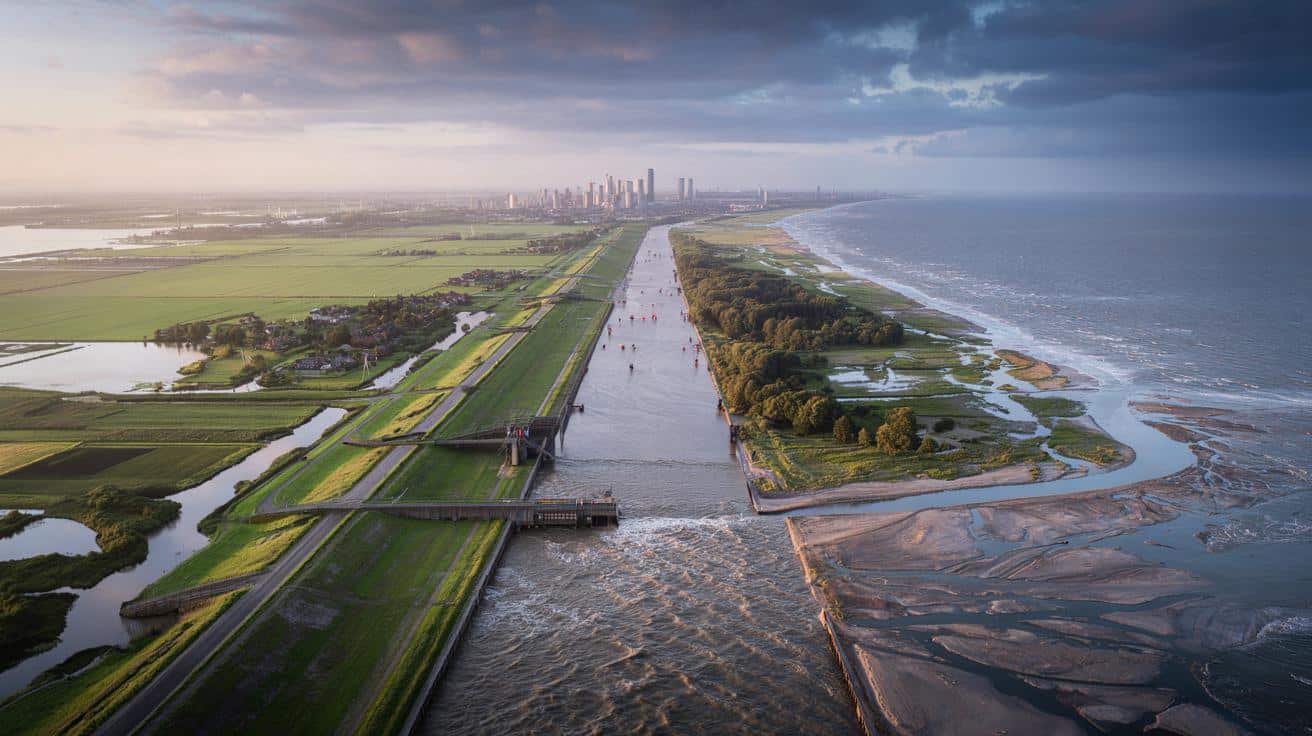
The sky over the Dutch coast looked perfectly calm that morning: flat grey, quiet waves, the kind of scene tourists photograph and forget. Standing on top of a dike in Zeeland, you don’t feel like you’re looking at a battlefield. You see cyclists, wind turbines, tidy farms stretching into the distance. Everything feels orderly, controlled, tamed.
Then a local activist points to a narrow canal vanishing into the horizon and says, almost casually: “That used to be a river mouth. We bent it.”
That’s when the landscape shifts.
You stop seeing postcard Holland and start seeing a country that has spent centuries cutting, diverting, and re‑wiring water flows far beyond its own borders.
And suddenly, the word on many experts’ lips doesn’t sound so exaggerated anymore.
Environmental colonialism.
When a water‑winning nation runs out of space
The Netherlands has always sold itself as the plucky underdog that “stole land from the sea.” It’s a compelling story: brave engineers, clever dikes, fields blooming where there once were waves. The national myth feels almost heroic, like a slow‑motion miracle carved out of mud and fog.
Yet as Dutch cities sprawl and the climate crisis tightens, the old techniques start to look less romantic. The country is tiny, crowded, and sinking. Pressure grows for more space, more safety, more fresh water.
So the same mindset that once fought the North Sea is now quietly stretching beyond Dutch borders, tweaking rivers upstream and reshaping coastlines downstream, often without those communities ever being told the full story.
Take the Rhine, that giant European river that eventually spills into the Dutch delta. On maps it looks almost natural, a blue snake threading through Switzerland, Germany, France, and then the Netherlands before meeting the sea. On the ground, it’s anything but.
➡️ The surprising reason this “healthy” food leaves so many people feeling bloated
➡️ This herbal tea touted on social media does more harm than good
➡️ Doctors warn: a wave of extreme fatigue is coming – here’s how to avoid it
Over the past century, Dutch authorities and engineers worked with upstream countries to straighten, deepen, and divert channels. Officially, it was about navigation, flood safety, and trade. But each “technical adjustment” also boosted Dutch control over freshwater flows and sediment, feeding ports, protecting polders, and stabilising their fragile coast.
People in German floodplains and French wetlands often learned about these projects when the water regime suddenly shifted. Their soils dried or their banks eroded, while Dutch ports thrived. On paper, it was cooperation. On the ground, it felt to many like someone else was quietly pulling the river strings.
Critics today call this pattern a form of **environmental colonialism**: a powerful, well‑financed state using infrastructure, law, and diplomacy to extract ecological benefits from shared systems. Not by sending soldiers, but by sending engineers and contracts.
They point to mega‑dams and barrages that alter sediment transport, so sand that once nourished Belgian or German coasts ends up feeding Dutch beach nourishment projects instead. They talk about river diversions that shift flood risks away from Rotterdam and towards less wealthy inland towns.
All this happens under the banner of “integrated water management,” a phrase that sounds technocratic and neutral. Yet behind it, there’s a simple asymmetry: the Netherlands has the money, data, and negotiating weight. Many neighbours do not. And water, once redirected, tends to obey those who can afford to build the walls.
How do you “steal land from the sea” in the 21st century?
On paper, the Dutch strategy looks almost elegant. You don’t just raise dikes higher and higher. You work with river basins far inland, so that by the time water reaches the coast, it behaves exactly how you want. A small diversion here, a controlled overflow there, a new side‑channel cut in between.
You also manipulate sediment. The Netherlands constantly battles coastal erosion. So engineers experiment with redirecting sand that used to flow naturally along the North Sea. Once, the sea decided where that sand went. Now, breakwaters, dredging contracts, and carefully placed groynes nudge it towards beaches that protect Dutch towns, industrial zones, and tourist resorts.
Nothing in this method screams “theft” at first glance. It’s framed as optimisation, as safety, as cleverness. *But follow the currents long enough, and you start seeing who quietly pays the price.*
The main mistake many of us make when we picture this is imagining tidy, one‑off projects. A dam here, a levee there, done. The truth is far messier. River engineering is cumulative. Small works layer over decades, long after the press releases have faded.
A “temporary” diversion channel for construction turns into a new normal for fish and farmers. A pilot sand nourishment alters wave patterns that affect a village two countries away. A port deepening request reshapes sediment flows for an entire coastline.
Locals living in low‑lying villages in northern Germany or along the Belgian coast sometimes wake up to new erosion rates, salinised fields, or more frequent nuisance flooding. They read about Dutch resilience awards and shining case studies, and feel strangely excluded from the celebration. Let’s be honest: nobody really reads 400‑page transboundary impact assessments before their backyard starts collapsing.
This is where the language shifts from “management” to accusation. Environmental justice campaigners, especially from the Global South, see a familiar pattern. Wealthy, technically advanced countries push ecosystems to serve their needs, then export the risk and damage.
A climate scholar from the Caribbean put it bluntly at a recent conference in Rotterdam:
“First they colonised our islands,” she said. “Now they colonise our rivers and our seas. The flag changed, the methods evolved, but the logic feels the same.”
In the Dutch case, critics highlight three recurring moves:
- Rewriting river rules through EU and bilateral deals that favour delta industries.
- Engineering coastlines so Dutch land gains protection while erosion shifts abroad.
- Framing these choices as neutral “best practice” that others should copy.
Some Dutch experts openly bristle at the word colonialism. Others quietly admit that when you win so often against water, you start believing the whole basin exists for your survival alone.
Where does that leave the rest of us?
What makes this story uncomfortable is that it isn’t about cartoon villains. It’s about a country genuinely scared of drowning, using every tool it has to stay afloat, and in the process reshaping a shared planet to fit its own outline. We’ve all been there, that moment when survival mode narrows your field of vision to your own doorstep.
This is why the Netherlands has become a model for climate adaptation tours. Delegations from Jakarta, Dhaka, Lagos, and Miami fly in to study Dutch dikes and delta plans. They walk along the same concrete paths in Zeeland, listen to the same polished presentations, hear about “Room for the River” and “Building with Nature.”
The questions that almost never make the slides are the most human ones: Who gets flooded so Rotterdam doesn’t? Whose coastline erodes so Amsterdam’s doesn’t? When your engineering genius runs up against someone else’s home, who gets to decide what “acceptable risk” looks like?
| Key point | Detail | Value for the reader |
|---|---|---|
| Shared rivers, unequal power | The Netherlands negotiates and designs projects on major European rivers with far greater technical and financial capacity than many neighbours. | Helps you spot when “cooperation” might hide imbalances and silent winners and losers. |
| Land from the sea, risk to others | Coastal engineering and sediment diversion often protect Dutch land while shifting erosion or flood risks down the line. | Invites you to question feel‑good climate stories that don’t mention who absorbs the side‑effects. |
| A new kind of colonialism | Control of water flows and ecosystems, framed as neutral expertise, can reproduce old colonial logics without troops or flags. | Gives you a lens to read other mega‑projects, from dams to sea walls, with more skepticism and nuance. |
FAQ:
- Is the Netherlands literally “stealing” land from other countries?
Not in the legal sense of crossing borders with bulldozers. The accusation is about **indirect impacts**: by diverting rivers, controlling sediment, and shaping water flows, Dutch projects can improve safety and space at home while increasing risks or degradation abroad.- What does “environmental colonialism” mean here?
It refers to a pattern where a powerful actor restructures ecosystems in shared basins for its benefit, exporting costs to less powerful communities. No formal empire, but a similar hierarchy: those with money and expertise extract safety, land, or resources; others live with the consequences.- Are these river and coastal projects secret?
Formally, many are public and go through environmental assessments and transboundary consultations. The “secret” part is more about opacity and complexity. Impacts are buried in technical documents, while public messaging focuses on innovation and resilience, not on who loses out.- Do Dutch experts acknowledge these criticisms?
Some do. A growing group of scholars, planners, and activists inside the Netherlands talk openly about justice, upstream–downstream power, and historical responsibility. Others push back, arguing that without these measures, millions of Dutch people would face catastrophic flooding.- What can be done differently?
Critics call for stronger cross‑border governance, real veto power for affected communities, transparent sharing of models and data, and funding to compensate or protect places that bear the downside. They also urge importing countries to question “Dutch solutions” before copying them wholesale in more fragile deltas.