The first thing people noticed wasn’t the darkness.
It was the silence.
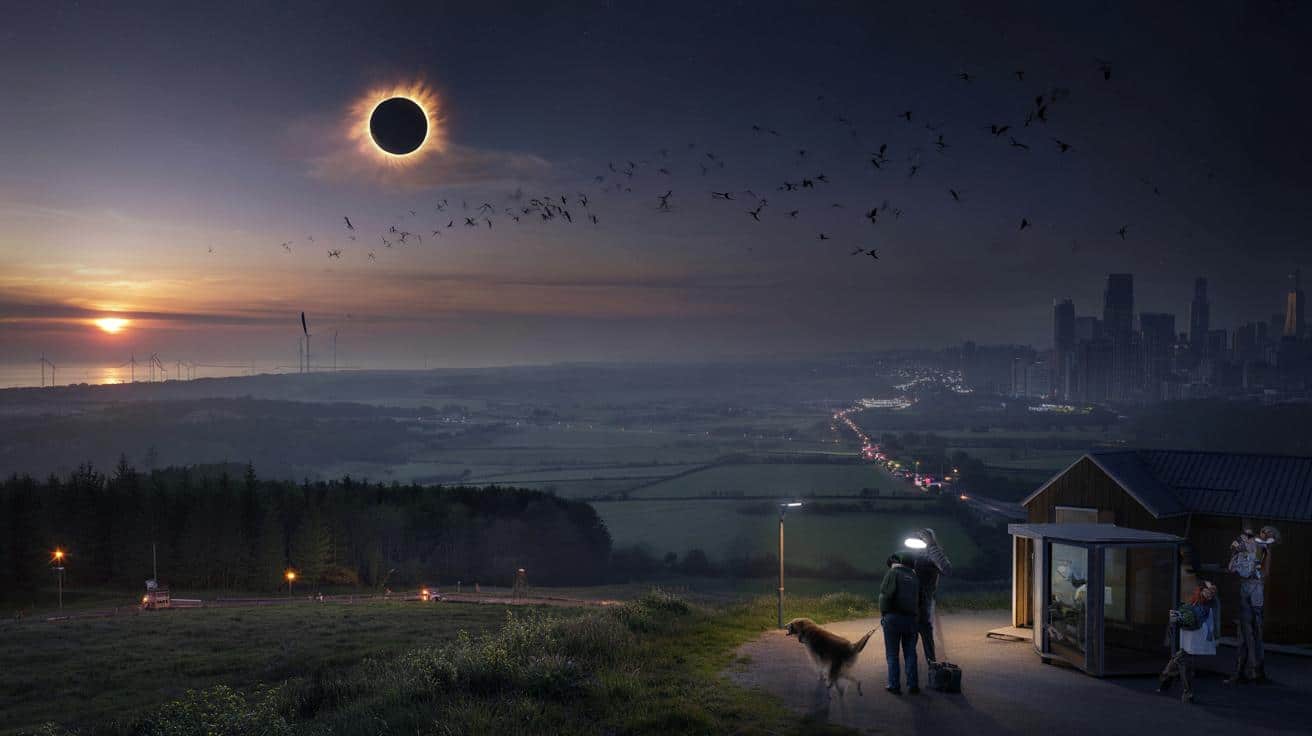
Outside a small observatory in Arizona, a group of volunteers rehearsed for the upcoming eclipse, timing how fast the light dimmed during last year’s partial event. Birds stopped singing mid-chorus. Dogs pulled closer to their owners. A flock of starlings wheeled once, then vanished into the treeline as if someone had flipped a switch.
One astronomer checked his stopwatch, frowned, and said quietly: “That was just a warm-up. Next time, this will last a lot longer.”
What happens when the sky goes wrong for much more than a moment?
The eclipse scientists are calling “a once-in-a-century stress test”
Across major space agencies, there’s a rare tone in the briefings about the coming eclipse. Not excitement. Caution.
The alignment of the Sun, Moon and Earth is expected to be so precise that the path of totality will stay dark longer than anything recorded in modern satellite data. We’re not talking about a quick, blurry wink of the Sun. We’re talking a deep, lingering blackout over a narrow, heavily populated track that cuts across continents and key ecosystems.
For scientists who track light, heat and life from orbit, this isn’t just a celestial show. It’s an experiment they didn’t design, but can’t afford to ignore.
At ESA’s mission control in Darmstadt, Germany, a wall of screens is already filled with trial simulations. One shows a sweeping shadow eating its way across farmland, coastal wetlands, megacities and offshore wind farms. Another screen tracks temperature drop forecasts along the path: a several-degree plunge compressed into less than ten minutes.
NASA, ESA and other agencies have quietly re-tasked satellites to stare at the same strip of Earth before, during and after the event. They want to see how fast the upper atmosphere cools, how smog layers shift, how power grids react when solar output vanishes and then slams back like a breaker being thrown.
On the ground, biologists are rushing to tag birds, bats and even bees in the eclipse corridor, trying to catch their real-time confusion in the dark.
➡️ This chicken and rice casserole cooks evenly without becoming dry
➡️ All people who have bread in the freezer are invited to read this information
➡️ The right way to clean stainless steel without streaks
➡️ Black Friday: this electric mountain bike built for rough trails drops €500 at Decathlon
➡️ Jura: “It endangers protected fish in our rivers”: the great cormorant in anglers’ sights
➡️ Not in the fridge or fruit bowl: the best place to keep strawberries so they don’t go mouldy
➡️ Psychology reveals why certain people feel uncomfortable when things finally slow down
Why the concern over a few extra minutes of night in the middle of the day?
Because Earth’s systems, from climate to coral reefs, run on timing as much as temperature. Many species use light patterns as their primary clock, not just night versus day, but the subtle curve of dawn and dusk. The upcoming eclipse compresses those cues into a brutal, unnatural jump cut: bright, then sudden twilight, then near-night, then blinding noon again.
Space agencies aren’t predicting catastrophe. They’re worried about stress. Stress on migrating animals, on crops mid-photosynthesis, on urban heat islands that cool too fast then bounce back harder. In a world already on ecological edge, this eclipse lands like a stress test on fragile timing.
How to live through a “cosmic blackout” without losing your own rhythm
You can’t control the Moon’s shadow, but you can decide how you move through it. One of the most practical pieces of advice from both space and health agencies is surprisingly simple: slow your day down around the eclipse window.
Plan errands, driving and outdoor work so you’re not rushing right as the light starts to fall. That sudden twilight can throw depth perception and reaction time off, especially in busy streets or on rural highways where wildlife is already unsettled.
Think of it less like a spectacle and more like a passing storm front. You’d pause, watch the clouds come in, adjust your pace. Do the same with the shadow.
There’s a quieter layer to all this: people’s bodies and moods react to unexpected changes in light, even when they tell themselves they’re fine. Sleep specialists point out that light is the main driver of our internal clock, and a mid-day plunge into darkness can leave some people strangely wired or oddly tired.
If you’re prone to migraines, anxiety spikes or sleep troubles, treat the eclipse day as you would a major time-zone jump. Hydrate, keep caffeine moderate, leave some buffer after the event instead of diving straight into high-stress tasks. We’ve all been there, that moment when a strange sky makes you feel small and a bit off-balance. That doesn’t mean you’re “too sensitive”; it means your brain is paying attention.
Space agencies are also urging people to think beyond the classic “don’t look at the Sun without protection” warning. Yes, eclipse glasses that meet ISO standards are non-negotiable for any direct viewing. *Your retinas don’t care how rare and beautiful the alignment is.*
But they’re adding a new layer of messaging this time, one that sounds more like climate communication than space PR:
“An eclipse isn’t just above you,” one NASA environmental scientist told me. “It’s inside every living thing that uses light as a signal. Watch the sky, but also watch what your world does when the switch flips.”
- Watch quietly for a minute
Notice birds, insects, pets and street noise as the light changes. - Keep pets close
Many animals show eclipse anxiety and may bolt or act unpredictably. - Give your eyes and brain breaks
Look away from the sky regularly to avoid strain and disorientation. - Record, don’t rush
If you’re filming, set up early so you’re not fumbling as the darkness hits. - Plan for the emotional hit
Some people feel awe, others dread. Both are valid, and both can linger after the shadow is gone.
When the shadow passes, the questions will stay
Once the Sun burns back through and shadows snap sharp again, the world will look “normal” in a few minutes. Traffic will thicken, people will pocket their phones, kids will wander back indoors. The show, for most, will feel over.
Yet for months, maybe years, scientists will comb through petabytes of data: satellite snapshots of darkened cities, ocean surface temperatures dipping along the path, insect swarms changing height in the cooled air. Biologists will compare heart-rate logs from tagged animals. Power engineers will replay the grid’s heartbeat as solar production vanished then surged. This eclipse will become a benchmark, a strange but precious natural experiment in a century obsessed with artificial ones.
There’s another layer, less measurable but just as real. Events like this tend to pry open questions we usually keep shut. Why does a small bite out of the Sun stir such old fear in our stomachs? How did our ancestors read these shadows without data, only stories and firelight? What does it say about us that we can predict the second the Moon will cross a satellite’s lens, yet still struggle to predict how a stressed forest or coral reef will behave in twenty years?
Let’s be honest: nobody really reads a warning from a space agency and instantly changes their habits every single day. But a sky going dark at noon has a way of cutting through our selective hearing.
Maybe that’s the hidden value of this “unmatched” eclipse. Not just the photos, not just the spike in traffic on space websites, but the collective pause it forces. A few minutes where millions feel—viscerally—that Earth is not a backdrop, it’s a moving part in a larger, fragile machine of light and shadow.
If you’re in the path, you’ll have your own version of that pause. A half-whispered “wow”, a restless dog, a sudden chill on your arms, an unplanned memory surfacing in the dark. Whether you’re worried about environmental tipping points, or just trying to keep your kids from staring straight at the Sun, this eclipse is an invitation: to watch closely, then talk about what you felt, what you noticed, what you’re still not sure about.
Those conversations, shared in the odd afterglow of noon-night-noon, may outlast the shadow itself.
| Key point | Detail | Value for the reader |
|---|---|---|
| Unusual alignment and duration | Space agencies say the eclipse’s precision and length have no match in modern satellite records. | Helps readers understand why this event is more than “just another eclipse”. |
| Environmental and biological stress | Rapid light and temperature shifts can disrupt animals, ecosystems and even human mood and performance. | Gives context for personal reactions and what to observe in nature during the event. |
| Practical preparation | Adjust schedules, protect eyes, manage expectations and use the moment as a slow-down rather than a stunt. | Offers concrete steps to stay safe, present and emotionally grounded on eclipse day. |
FAQ:
- Question 1Are space agencies predicting a disaster from this eclipse?
No. Agencies are not forecasting catastrophe, but they are treating the event as a rare stress test for ecosystems, infrastructure and observation tools.- Question 2What makes this eclipse different from past ones?
The combination of its precise alignment, longer duration of totality in some regions and its path over densely monitored and populated areas sets it apart in modern records.- Question 3Can the eclipse affect my health directly?
The biggest direct risk is eye damage from looking at the Sun without proper protection. Indirectly, sudden light changes can influence mood, headaches and sleep patterns in sensitive people.- Question 4Will animals really act strangely during the eclipse?
Yes, many species respond to the sudden darkness as if night is falling. Birds may roost, insects may change activity, and pets can become anxious or disoriented.- Question 5What’s the best way to experience the eclipse responsibly?
Use certified eclipse glasses, slow your day around the event, observe how your surroundings react, and give yourself a bit of quiet time afterward to reset and, if you can, share what you noticed with others.