The first sign is not the darkness.
It’s the silence.
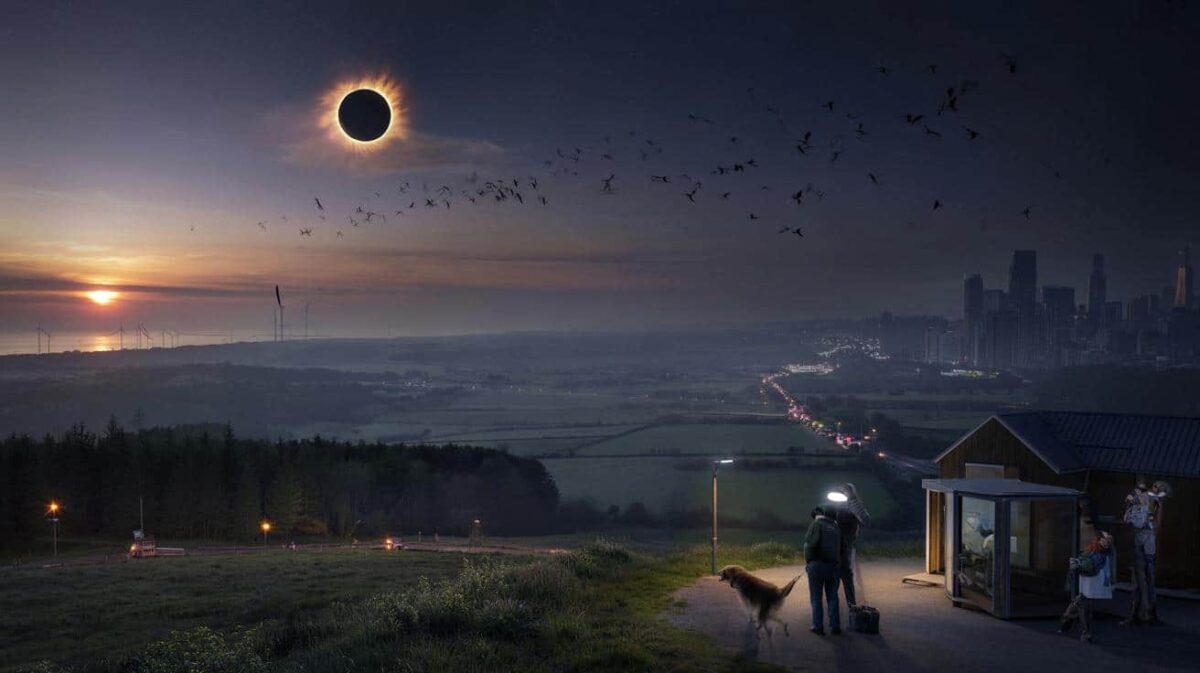
In a small town where the main street still smells like coffee and hot asphalt at 10 a.m., people step outside, squinting at a sun that suddenly looks… wrong. Shadows sharpen, then stretch, then blur. Birds cut their songs mid-note. A dog whines and tugs at its leash, as if someone just turned down the volume on the world.
Phones go up, lenses pointed skyward, while the sky itself begins to drain of color faster than feels safe. You can feel the crowd’s chatter thinning, replaced by a nervous, shared breath.
Somewhere above all of this, the Moon is moving in a way it almost never does.
And astronomers say this time, the darkness will last.
A record-breaking eclipse that bends our sense of time
Astronomers across several observatories have now confirmed the calculations: the upcoming solar eclipse won’t just be another quick celestial show. It will be one of the longest totalities humans alive today have ever seen.
Under the path of totality, people won’t be plunged into a brief dusk for a couple of minutes. They’ll lose daylight for what experts describe as an “unprecedented” stretch, long enough for your body to stop thinking “wow” and start wondering “what is happening to me?”.
The numbers are precise. The feeling, much less so.
At the Cerro Tololo Inter-American Observatory in Chile and several European facilities, teams ran independent simulations of the Earth–Moon–Sun geometry for this eclipse. They all converged on the same unsettling conclusion: totality in some zones will approach the theoretical maximum the Earth–Moon system allows, stretching past the familiar three or four minutes and edging toward the deep end of the scale.
One researcher described the final model run as “watching the clock slow down on the screen.” You see the Moon’s shadow track across the planet, but the dark core hangs over certain regions, barely budging. For the people inside that shadow, those extra increments of time will feel strangely elastic.
On paper, the explanation sounds simple. The longest eclipses happen when a few rare things line up: the Moon is unusually close to Earth, the Earth is near its farthest point from the Sun, and the shadow cuts a path close to the equator where the planet spins fastest. Add a favorable angle between the orbital planes and the geometry stretches the shadow’s footprint like taffy.
➡️ Lower in calories than rice or pasta, this is the lightest starch for making a mixed salad
➡️ Spotless shower screens: the hotel trick for streak-free glass
➡️ Workers in this field often earn more by staying in one niche
➡️ Forget vinegar and baking soda: this half-glass trick clears any drain on its own
Astronomers have known the theory for decades. What they hadn’t seen in modern times, with our crowded cities and fragile power grids, was an event this close to the upper limit.
The numbers line up cleanly. Human nerves do not.
Why the darkness will feel so abrupt — and so disorienting
Ask anyone who’s watched a total eclipse: the weirdness doesn’t wait for totality. It starts with the light.
As the Moon begins to slide in front of the Sun, your brain thinks the day is normal. Then the shadows turn razor sharp. Colors flatten. The temperature drops just enough to prickle your skin. Your instincts, tuned by a lifetime of regular dawns and sunsets, suddenly have nothing to hold on to.
Astronomers warn that during this eclipse, that transition from “pretty strange” to “deeply wrong” will happen faster than most people expect, especially near the centerline of the shadow.
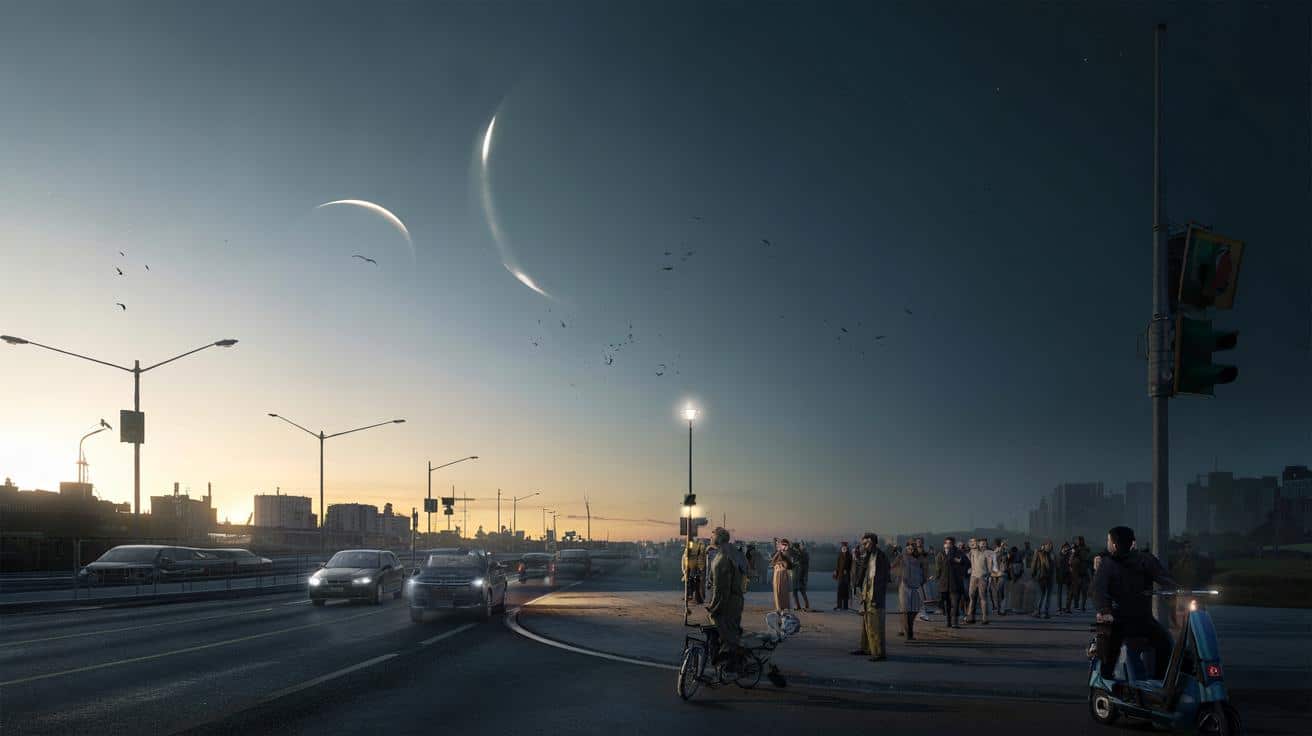
Picture a mid-morning rush on a busy ring road around a major city. Cars flowing, trucks humming, cyclists weaving through side streets. The light is bright, slightly golden. Then, within a handful of minutes, the contrast spikes, traffic lights look unnaturally bright, and a gray-blue filter seems to settle over everything.
Just as drivers start to notice, the Sun is swallowed.
You’re in an eerie twilight. Streetlights, on automatic sensors, flick to life mid-commute. Birds circle and roost in parking lots. A kid on an electric scooter brakes without quite knowing why. Time hasn’t stopped, but it feels like it missed a step. That perceptual jolt, multiplied by the record length of this totality, is what has scientists talking less like mathematicians and more like psychologists.
There’s a plain-truth sentence floating in nearly every astronomer’s comment on this: **our brains are not designed for midday night.**
Circadian rhythms expect slow transitions. Dawn bleeds into day, dusk into night. The hormone mix in your body, your alertness, your mood — all are paced by gentle slopes of light change. The coming eclipse yanks that slope into a cliff.
When that darkness lingers, your internal clock starts sending mixed signals. Some people feel drowsy. Others get jittery. A few experience a quiet, almost primal fear that has nothing to do with understanding astronomy.
*You can know every detail of the orbital mechanics and still feel that ancient animal part of you go on high alert.*
How to stay grounded when the sky turns off like a switch
You can’t control the sky, but you can script your own reaction. The first practical gesture is simple: decide where you’ll be when the shadow hits.
If you live in the path of totality, plan your viewing spot as if you were choosing a safe place to watch a storm roll in. Open space, away from major roads, ideally with a clear horizon. A school field, a park, a rooftop terrace with secure access. The worst scenario is feeling that sudden darkness while you’re stuck behind the wheel on a busy junction.
Stopping your normal activity on purpose is the quickest way not to panic when the world suddenly looks anything but normal.
We’ve all been there, that moment when the lights go out in a supermarket and the room inhales. You don’t know whether to laugh, freeze, or keep walking. The eclipse will echo that feeling, just on a bigger, more cosmic scale.
So you give your brain a script in advance. Tell your kids, your parents, your coworkers: “At this time, the sky will go dark. We’ll step outside. We’ll watch. Then it will come back.”
Avoid the common mistake of treating it like just another photo-op. Your nervous system is in the room too. **Have eclipse glasses ready, choose a meeting point, and talk through the timeline like you would for a fire drill.** It sounds over-prepared, yet that kind of rehearsal is what turns panic into awe.
Astrophysicist Lina Mercado, who has studied human reactions to past eclipses, puts it bluntly: “The danger is not mystical. It’s distraction, crowd behavior, and people underestimating how strange they will feel when the Sun disappears for that long. Preparation is not about fear. It’s about leaving space for wonder without chaos.”
- Have certified eclipse glasses and a backup pair stored in a safe, obvious place.
- Block out the eclipse window in your calendar so you’re not driving or operating machinery.
- Decide ahead who you’ll be with and where you’ll stand or sit.
- Explain the event in simple terms to children, elderly relatives, or anxious friends.
- Lower expectations about filming; prioritize experiencing the moment directly.
The rare night-at-noon we’ll talk about for years
A century from now, someone will scroll through an old archive and read that, on this date, people in a narrow ribbon across the Earth watched noon turn into night for longer than their grandparents thought possible.
Some of them will remember the science: how the Moon’s orbit and Earth’s tilt lined up just so. Others will remember goosebumps on their arms, the way the air went slack, the collective gasp when the Sun’s corona flared into view.
The astronomers’ warnings about abrupt daylight loss and deep disorientation are not about dampening the magic. They’re about leaving room for it. The more we understand the mechanics and the psychology, the more freely we can stand in that impossible darkness and feel, even briefly, like we are small, and lucky, and very awake.
| Key point | Detail | Value for the reader |
|---|---|---|
| Unprecedented duration | Geometry of Earth–Moon–Sun will push totality close to theoretical limits in some regions | Helps you grasp why this eclipse is different from recent ones |
| Abrupt light loss | Fast transition from bright daylight to deep twilight during normal waking hours | Prepares you psychologically for the strange sensory experience |
| Practical planning | Choose location, avoid driving, explain the event to others, have proper gear | Reduces risk and anxiety so you can fully enjoy the phenomenon |
FAQ:
- Question 1How long will the total eclipse last in the zones with “unprecedented” duration?In the central parts of the path, astronomers expect totality to stretch well beyond the usual 2–3 minutes, approaching the maximum possible duration for our current Earth–Moon configuration.
- Question 2Is this eclipse dangerous to my health?The main physical risk is eye damage from looking at the Sun without proper protection outside totality. The disorientation is psychological, not toxic or radioactive.
- Question 3Can the sudden darkness affect power grids or technology?Large-scale impacts are unlikely, but temporary changes in solar input can influence local temperatures and, in rare cases, demand patterns on heavily loaded grids.
- Question 4Why do astronomers say this one will feel more disorienting than usual?The combination of an abrupt light drop, an unusually long totality, and the timing during active daytime hours heightens sensory and emotional effects.
- Question 5What’s the best simple way to prepare?Know the exact time for your location, decide where and with whom you’ll watch, get certified eclipse glasses, and avoid being on the road during the core event.