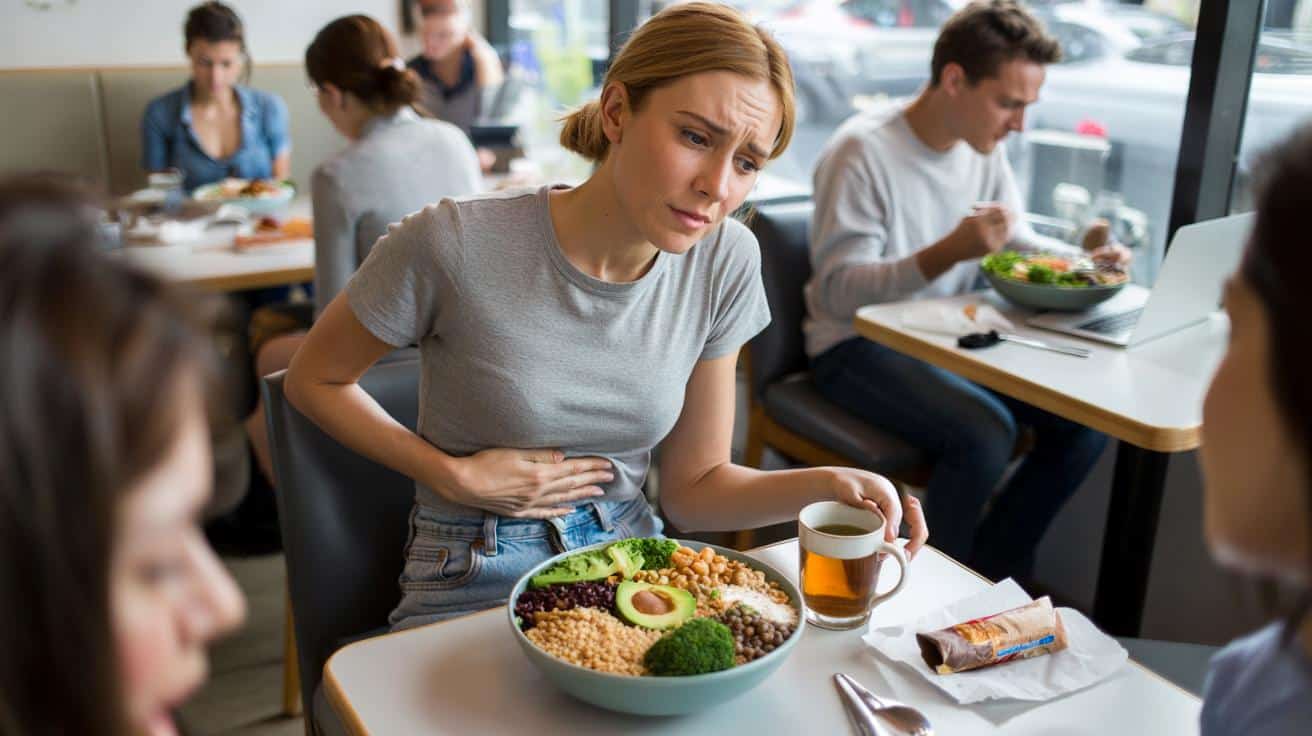
The woman at the next café table looked genuinely betrayed by her salad. You could see it in the way she pressed a hand to her stomach, the way she pushed her half‑eaten bowl of quinoa and chickpeas away. Her friend was saying, “But it’s healthy, right? It’s supposed to be good for you,” as if that made the discomfort disappear.
A few minutes later, she ordered peppermint tea and discreetly unbuttoned her jeans. The “wellness” lunch had turned into an afternoon of bloat, tight waistbands, and that heavy, swollen feeling so many of us know too well.
We’re eating better than ever on paper. Yet so many of us feel worse.
The culprit is hiding in plain sight.
The “healthy” food behind your 4 p.m. bloat
Think about your last “I’m going to be good today” lunch. Maybe it was a big salad with lentils. Or a Buddha bowl with brown rice, roasted chickpeas, avocado, and a mound of crunchy raw veggies. You walk away feeling proud… and then, a few hours later, your abdomen quietly starts to inflate like a balloon.
By the time you’re back at your desk or on the school run, your energy has dipped and your belly feels distended and tight. You loosen your belt one notch and wonder what you did wrong when all you ate was “clean” food.
This scene plays out every day in offices, gyms, and co‑working spaces. Colleagues gather around with meal-prepped boxes of black beans, broccoli, and whole grains. Someone jokes about looking “six months pregnant” after lunch. Someone else swears they’re “allergic to healthy food” because every time they swap their sandwich for a grain bowl, they pay for it.
One survey in Europe found that around 20–30% of adults regularly report feeling bloated, and many of them actually blame “healthy” meals more than fast food. Not the burger. The lentils.
The surprising reason so many people feel like this comes down to one word: fiber. That beloved nutrient we’re constantly told to eat more of. The beans, lentils, chickpeas, whole grains, cruciferous veggies, nuts, seeds – the very building blocks of the Instagram‑perfect wellness plate.
Fiber isn’t bad; it’s essential. The problem is that our gut bacteria need time, diversity, and training to handle a sudden fiber onslaught. When your microbiome isn’t used to it, those innocent chickpeas and that halo‑glowing cabbage salad get fermented fast. Gas builds up. Pressure increases. And your “healthy” lunch suddenly feels like a brick.
How to eat fiber without turning into a balloon
The first move isn’t cutting out fiber. It’s dialing the volume knob instead of slamming it from 0 to 100. If your usual lunch is a white baguette and cheese, leaping straight into a triple‑bean salad with extra broccoli is like sending your gut to bootcamp on day one.
Start by adding one higher‑fiber food at a time and watching how you feel. Half a cup of lentils, not two. A small handful of chickpeas sprinkled on your salad, not an entire bowl. Swap white rice for half‑white, half‑brown. Give your microbiome a ramp, not a cliff.
➡️ Wood-burning stove: the object to place near your firewood this winter
➡️ Chefs explain why seasoning cast iron at low heat lasts much longer
➡️ Spotless shower screens: the hotel trick for streak-free glass
➡️ Workers in this field often earn more by staying in one niche
➡️ Cotton buds aren’t meant for cleaning your ears – they have another use almost nobody knows
Then, think about texture and how “tough” your healthy foods are. Lightly cooking vegetables can make a huge difference. Steamed broccoli is usually far kinder to a sensitive gut than raw florets. Roasted carrots often pass more peacefully than crunchy crudités.
We’ve all been there, that moment when you finish an heroic raw kale salad and instantly regret your life choices. Massaging kale with a bit of oil, or choosing softer greens like spinach or lamb’s lettuce, often turns that regret into relief. Your stomach doesn’t need to wrestle every leaf into submission.
There’s also a hidden multiplier: how fast, and how stressed, you eat. You can have the most perfectly balanced bowl on earth and still end up bloated if you inhale it between emails. Less chewing means bigger particles reaching the gut. Bigger particles mean more fermentation, more gas, more pressure.
*Your gut doesn’t just need the right foods, it needs the right pace.*
- Slow down your first ten bites – deliberately chew more than feels natural.
- Drink water throughout the day, not just chugged with the meal.
- Start with smaller portions of beans and cruciferous veggies and build up over a few weeks.
- Add “buffers” like white rice or potatoes so the meal isn’t 100% fiber bombs.
- Pay attention to timing: some people tolerate fiber better at lunch than late at night.
The other players: FODMAPs, labels, and your unique gut
Fiber isn’t working alone. A whole family of carbs called FODMAPs – found in foods like onions, garlic, apples, wheat, some dairy, and many of those saintly legumes – pull water into the gut and are fermented by bacteria. For people with a sensitive digestive system or IBS, that combo can mean cramping, gas, and visible bloat.
So the innocent hummus wrap with onion, garlic, whole wheat, and a side of apple slices? That’s a quadruple hit of gut‑challenging ingredients. Nutritious on paper, but dynamically intense once it hits your intestines.
Then there are the “health halo” products lining supermarket shelves. Protein bars loaded with chicory root fiber. Low‑sugar yogurts sweetened with sugar alcohols like sorbitol or xylitol. High‑fiber wraps boosted with inulin. All technically good for your digestion… if your digestion can cope.
For many people, these concentrated fibers and sweeteners behave like a whoopee cushion in the gut. Lots of gas, strange noises, impressive bloat. Let’s be honest: nobody really reads every line on the back of the package every single day. Yet those tiny words – inulin, fructo‑oligosaccharides, sugar alcohols – often explain your sudden “I can’t button my jeans” moment.
The tricky part is that two people can eat the exact same impeccable salad and have totally different outcomes. One walks away energized and light. The other feels like they’re carrying a warm, inflated bowling ball under their ribs. That’s the microbiome in action – billions of bacteria that shape how your body handles every bite.
If you suspect specific foods are your trigger, a short, structured experiment with a dietitian can be life‑changing. Not a forever restrictive diet, but a few weeks of gentle testing: swapping beans for lentils, trying sourdough instead of regular bread, easing onion and garlic back in slowly. The goal isn’t a perfect plate. It’s a plate your body can actually live with.
Where do you go from here?
Maybe your “healthy” food villain is chickpeas. Or raw broccoli. Or the innocent handful of cashews you kept blaming on hormones or stress. Once you see the pattern, it’s oddly liberating. You’re not failing at wellness. Your gut just has a personality, and it’s giving you feedback in the only language it knows: pressure, gas, discomfort.
Some days, that feedback will nudge you toward gently cooked vegetables and smaller portions of legumes. Other days, you’ll notice that you handle a big crunchy salad surprisingly well… as long as you didn’t wolf it down at your laptop.
You don’t have to choose between “eating healthy” and feeling comfortable in your own body. Quiet tweaks – more chewing, less ultra‑processed “high‑fiber” bars, gradual increases instead of heroic jumps – often bring that calm, flat-ish feeling back.
What changes when you stop labeling yourself as “someone with a bad stomach” and start seeing yourself as someone learning their own manual? Your bloating becomes data, not a disaster. Your meals become experiments, not tests you’re failing. And your next quinoa bowl might just be something you enjoy… instead of something you secretly dread.
| Key point | Detail | Value for the reader |
|---|---|---|
| Gradual fiber increase | Shift from sudden high‑fiber meals to step‑by‑step changes | Reduces gas and bloat while keeping the benefits of fiber |
| Watch FODMAP clusters | Onions, garlic, beans, wheat and certain fruits can stack effects | Helps identify why specific “healthy” meals trigger symptoms |
| Eating style matters | Speed, stress, and chewing change how your gut handles food | Gives you practical levers to ease bloat without a strict diet |
FAQ:
- Question 1Why do I feel more bloated after a salad than after pizza?
- Question 2Which “healthy” foods are most likely to cause gas and bloat?
- Question 3Should I cut out beans, lentils, and cruciferous veggies completely?
- Question 4How long does it take for my gut to adapt to more fiber?
- Question 5When is bloating a sign I should see a doctor?