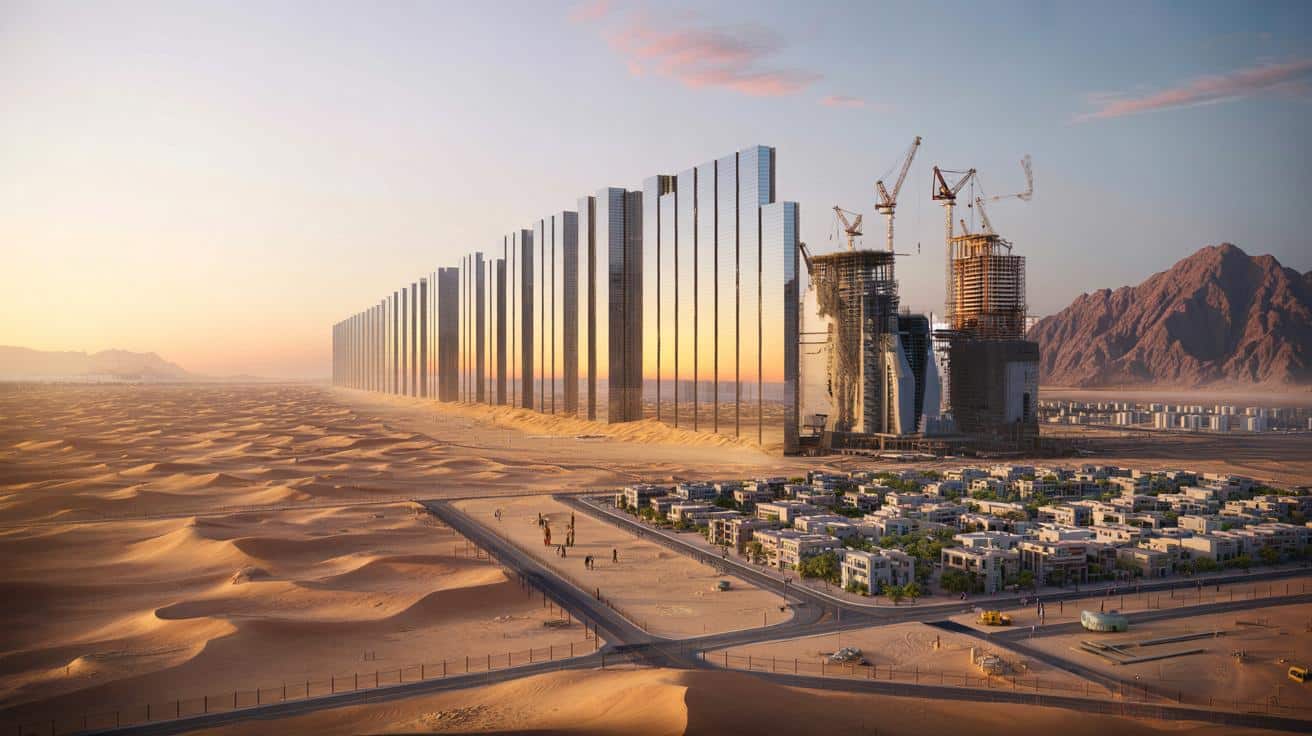
Saudi officials are now rethinking Neom’s most futuristic vision, The Line, after years of delays, ballooning costs and worries about how much more the kingdom can afford to pour into a single mega-project.
From limitless ambition to tighter budgets
Neom was unveiled in 2017 as the sharpest symbol of Crown Prince Mohammed bin Salman’s Vision 2030 programme, promising to pivot the Saudi economy away from oil and into high-end real estate, tourism and technology. At its core sat The Line: a city of two parallel skyscrapers stretching roughly 200km through the desert, 500 metres high and clad in mirrors.
The original plan imagined a home for around 9 million residents, stacked vertically along a narrow strip with no private cars, no roads and no direct emissions. Everything, from schools to shops, would lie within a 15‑minute walk. The project’s estimated price tag hovered around $500bn (£395bn).
The Saudi government has already spent an estimated $50bn on Neom, yet only a fraction of its grand vision exists on the ground.
According to people briefed on internal discussions, officials raised alarms about the project’s financial strain and the mounting risk of missing self-imposed deadlines. Work on some parts of The Line was quietly paused at the end of last year while Riyadh searched for a cheaper, more realistic approach.
A ‘far smaller’ Line as priorities shift
Sources familiar with the latest thinking say the crown prince now backs a “far smaller” version of The Line. The scale of the downsizing has not been finalised, but expectations that the full 100‑mile desert wall of glass will ever be built have largely evaporated.
One senior Saudi official speaking at a major investment conference in Riyadh last November captured the mood bluntly.
“We rushed at 100 miles an hour. We are now running deficits. We need to reprioritise.”
That reprioritisation appears to mean fewer kilometres of the linear city, a slower build-out and a shift in focus to projects with clearer economic returns. Insiders say the crown prince has grown frustrated with delays and is now pushing for a more grounded plan that can reassure investors and calm nervous technocrats in the finance ministry.
Neom’s new pitch: AI and data instead of pure spectacle
As the physical size of The Line shrinks, Neom’s strategic role may be changing. Reports suggest planners are increasingly steering the project towards becoming a regional hub for data centres and artificial intelligence infrastructure.
➡️ This chicken and rice casserole cooks evenly without becoming dry
➡️ The right way to clean stainless steel without streaks
➡️ Jura: “It endangers protected fish in our rivers”: the great cormorant in anglers’ sights
➡️ Black Friday: this electric mountain bike built for rough trails drops €500 at Decathlon
➡️ All people who have bread in the freezer are invited to read this information
➡️ Psychology reveals why certain people feel uncomfortable when things finally slow down
➡️ Not in the fridge or fruit bowl: the best place to keep strawberries so they don’t go mouldy
This dovetails with the crown prince’s ambition to turn Saudi Arabia into a heavyweight in AI and digital services. Vast tracts of desert, relatively cheap land, access to renewable power and proximity to Europe, Asia and Africa make the Neom area attractive for hosting energy-hungry data facilities.
- Smaller, denser urban footprint instead of a 200km city
- Greater emphasis on digital infrastructure and AI
- Phased development tied to budget realities
- More modest population targets in the near term
What remains unclear is whether a scaled-down Line will still form the visual and conceptual centrepiece of Neom, or whether it will be reduced to a short showpiece segment rather than a full-length linear city.
Oil price pressures and political calculations
The rethink comes as Saudi Arabia grapples with the twin challenge of heavy spending commitments and weaker-than-hoped oil revenues. Years of large capital projects, from infrastructure to entertainment and defence, have placed stress on public finances. A slump in oil prices only sharpened those pressures.
Neom, which once symbolised almost limitless ambition, has turned into a test case for how far the kingdom can go while still keeping its books in order. Cutting back The Line allows Riyadh to send a signal to investors and credit markets that it is willing to rein in spectacle when the numbers stop adding up.
Scaling down Neom is less about abandoning the future than about convincing sceptics the future can actually be paid for.
Sindalah: Neom’s first showcase falters
So far, only one part of Neom has officially opened its doors: Sindalah, a luxury yachting island in the Red Sea. Marketed as an exclusive playground for the global elite, the resort finally held its “grand opening” in October 2024, three years behind schedule and at roughly triple its original budget.
The launch, which reportedly involved performances from major celebrities including Will Smith and Alicia Keys, was meant to showcase Neom’s glamour. Instead, it highlighted the project’s cost overruns and delays. The crown prince was said to be unimpressed by the inflated bill and has since dismissed Neom’s chief executive, Nadhmi al‑Nasr.
| Project element | Original vision | Current reality |
|---|---|---|
| The Line | 200km mirrored megacity, 9m residents | Scaled-down, uncertain length and population |
| Budget | ~$500bn total for Neom | ~$50bn spent so far, future cuts likely |
| Sindalah resort | Opening in 2021, controlled costs | Opened 2024, around three times over budget |
The environmental promise meets engineering reality
The Line was pitched as a radical answer to climate concerns and urban sprawl. The concept boasted 100 per cent renewable energy, zero direct emissions, and protection of 95 per cent of surrounding land for nature. Dense vertical living would replace cars with high-speed transit and autonomous shuttles.
Urban planners and engineers, though, questioned whether this kind of linear city could work in practice. Keeping essential services, transport and utilities efficient along a 200km strip poses immense challenges. Small design errors multiply when stretched across such distances. The wider Neom site also lies in a harsh desert environment, where cooling, water desalination and maintenance all come with high costs.
A smaller build may help reconcile some of those tensions. A shorter stretch of The Line could still act as a test bed for low-carbon design and new forms of public transport, without demanding the same level of engineering gymnastics as a full 100‑mile megastructure.
What a scaled-back Neom could actually look like
If Saudi planners lean into pragmatism, Neom over the next decade might look less like science fiction and more like a cluster of high-tech coastal communities. Instead of a single continuous wall, the project could evolve into several compact districts linked by high-speed rail and highways, each with a different economic focus: tourism, logistics, data, clean energy.
A more incremental approach allows the government to test demand before building the next phase. It also offers flexibility if global economic conditions change or if political pressure mounts to redirect funds towards housing, healthcare or jobs in existing cities.
Key concepts behind the megacity experiment
For readers trying to make sense of the jargon around Neom, a few terms are helpful:
- Linear city: An urban model where development stretches in a long line, rather than in a circle or grid. The idea dates back to early 20th‑century planners but has rarely been attempted at this scale.
- Data centre hub: A cluster of large facilities hosting servers and digital infrastructure. These hubs underpin cloud computing and AI services, and they consume significant electricity and water for cooling.
- Vision 2030: Saudi Arabia’s national strategy to cut reliance on oil revenues by boosting tourism, entertainment, manufacturing and technology.
If Neom successfully pivots toward AI and data services, the economic impact could ripple across the region. A concentration of data centres can attract chip makers, cloud providers, cybersecurity firms and specialist construction companies, creating an ecosystem that survives even if the most extravagant architecture never emerges from the sand.
There are risks. Heavy investment in energy-hungry digital infrastructure raises questions about water use, carbon footprints and long-term demand. A downturn in global tech spending, or tougher international rules on data storage, could leave expensive facilities underused. Balancing glossy visions with practical returns will decide whether the scaled-back Neom becomes a quietly profitable tech corridor, or remains an unfinished monument to an era of easy oil money and restless ambition.